Eri Odeyemi

Show of Hands

Selected work / Historic Waters Community Association
CASE STUDY 03 | OPERATIONS TOOLKIT

Client

Historic Waters Community Association

My role

Strategy and Operations Consultant

Timeline

Jun to Aug 2026

Team

10 students

Methods

Systems mapping, stakeholder audit, co-creation workshop

The question

A volunteer-led corridor association in Savannah had energy and partners, but struggled to turn meetings into decisions and action.

What I did

Diagnosed four systemic gaps through systems mapping, a stakeholder audit and a co-creation workshop, then designed the operating model using an OGSM framework.

Outcome

Show of Hands, a 15-tool toolkit for running meetings, handed over to the association along with its operating model.

The brief
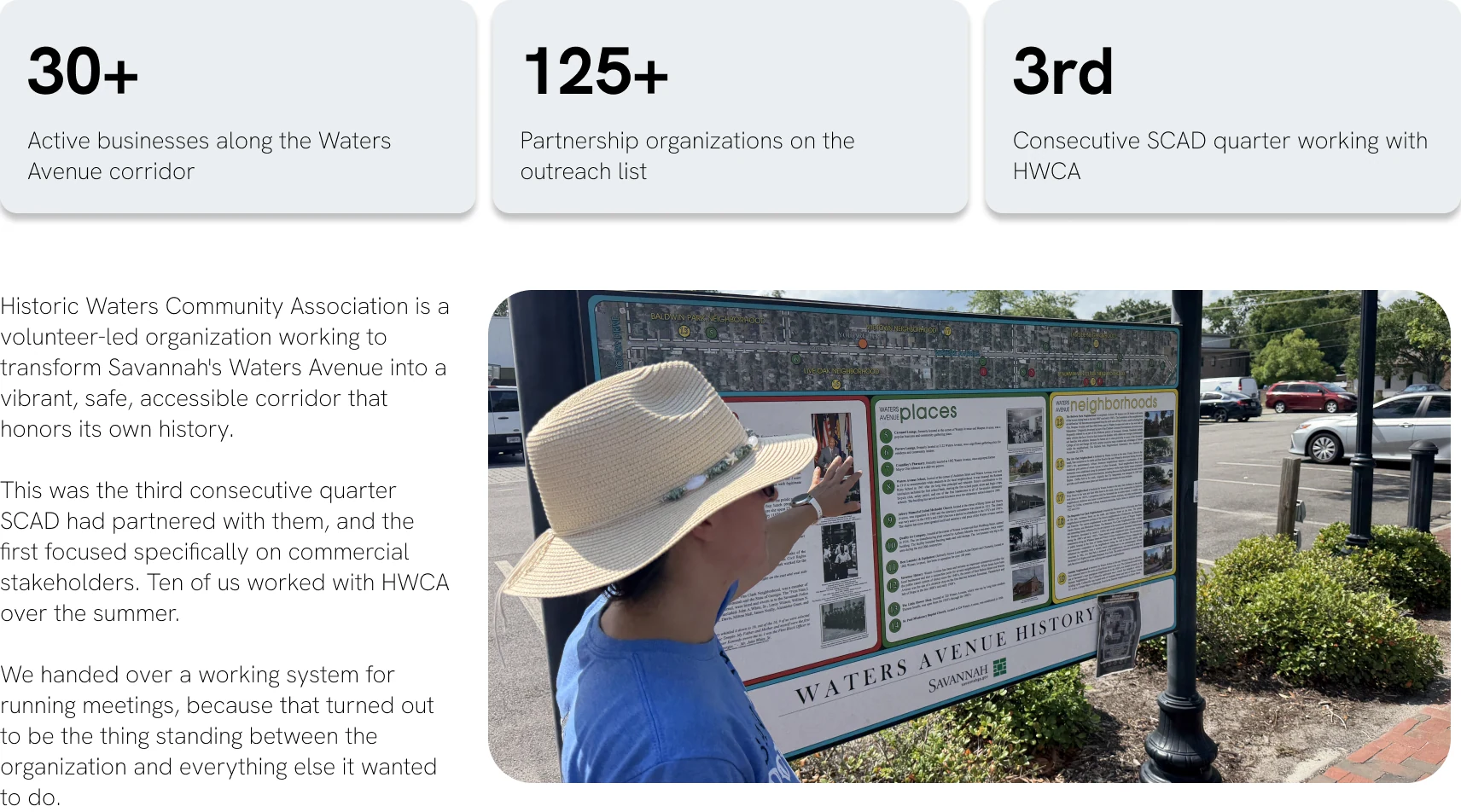
30+ | Active businesses along the Waters Avenue corridor | 125+ | Partnership organizations on the outreach list | 3rd | Consecutive SCAD quarter working with HWCA | Historic Waters Community Association is a volunteer-led organization working to transform Savannah's Waters Avenue into a vibrant, safe, accessible corridor that honors its own history. This was the third consecutive quarter SCAD had partnered with them, and the first focused specifically on commercial stakeholders. Ten of us worked with HWCA over the summer. We handed over a working system for running meetings, because that turn

Entity, relation, attribute and flow map
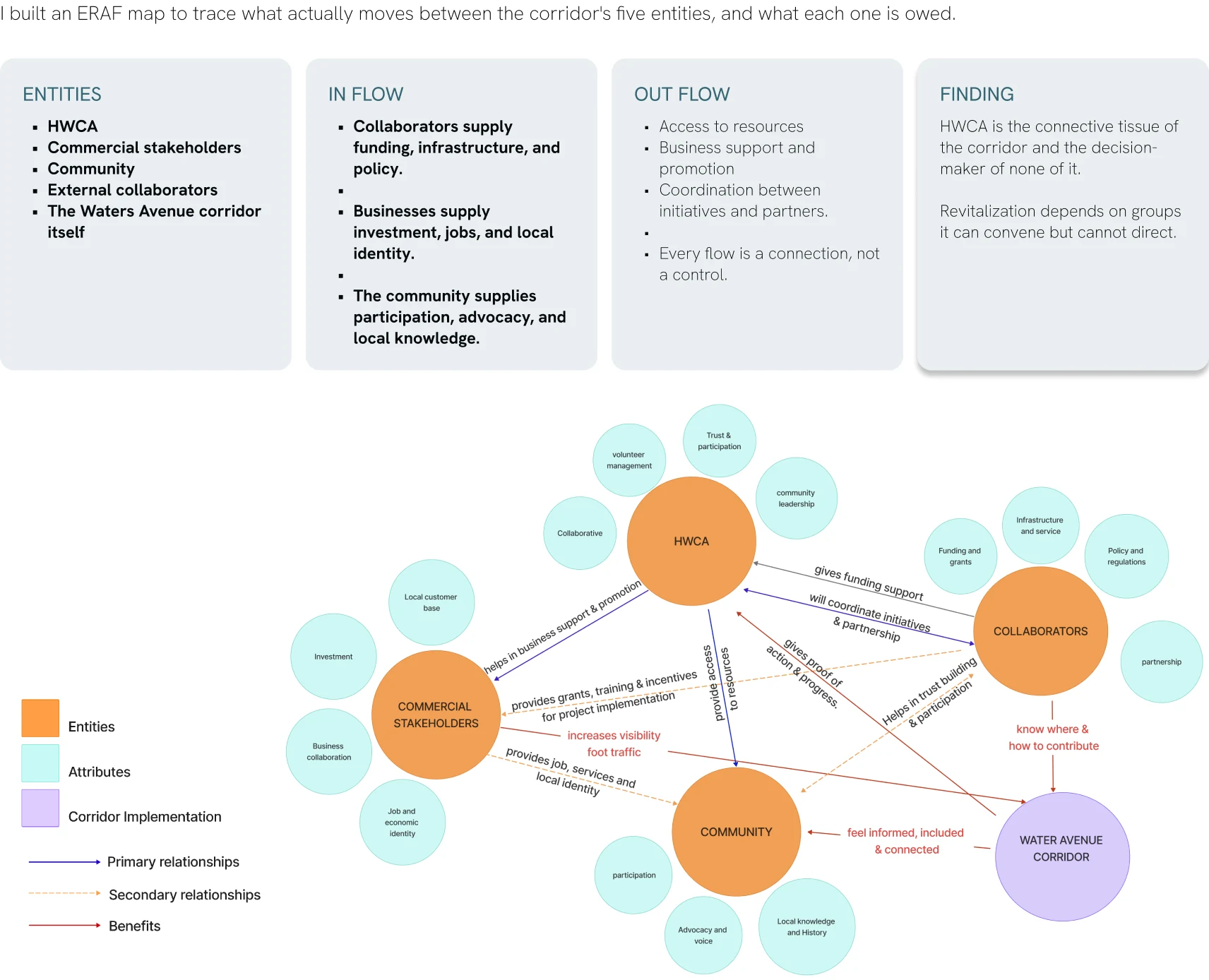
I built an ERAF map to trace what actually moves between the corridor's five entities, and what each one is owed. | Entities | HWCA Commercial stakeholders Community External collaborators The Waters Avenue corridor itself | IN FLOW | Collaborators supply funding, infrastructure, and policy. Businesses supply investment, jobs, and local identity. The community supplies participation, advocacy, and local knowledge. | OUT FLOW | Access to resources Business support and promotion Coordination between initiatives and partners. Every flow is a connection, not a control. | Finding | HWCA is the conn

Performance attributes

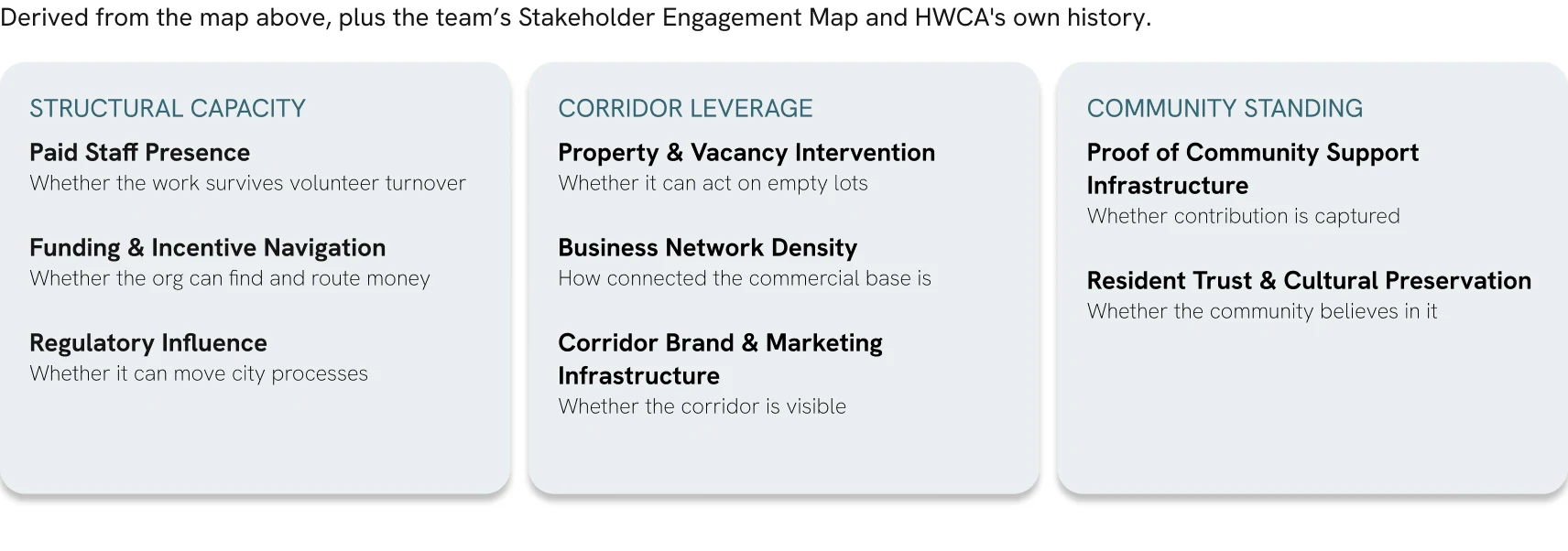
Derived from the map above, plus the team’s Stakeholder Engagement Map and HWCA's own history. | STRUCTURAL CAPACITY | Paid Staff Presence Whether the work survives volunteer turnover Funding & Incentive Navigation Whether the org can find and route money Regulatory Influence Whether it can move city processes | CORRIDOR LEVERAGE | COMMUNITY STANDING | Property & Vacancy Intervention Whether it can act on empty lots Business Network Density How connected the commercial base is Corridor Brand & Marketing Infrastructure Whether the corridor is visible | Proof of Community Support Infrastructure

Aspirational case studies

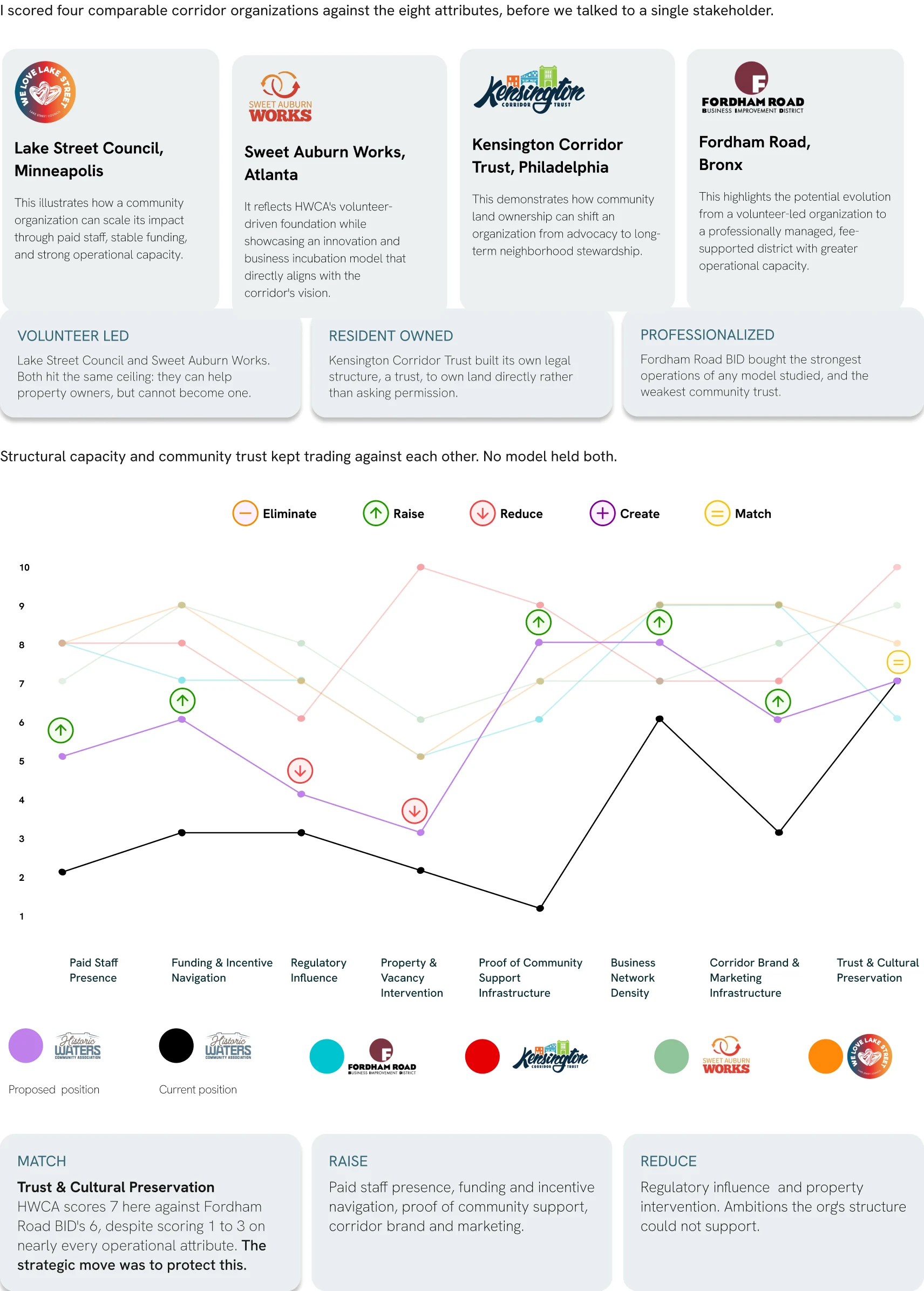
I scored four comparable corridor organizations against the eight attributes, before we talked to a single stakeholder. | Structural capacity and community trust kept trading against each other. No model held both. | VOLUNTEER LED | Lake Street Council and Sweet Auburn Works. Both hit the same ceiling: they can help property owners, but cannot become one. | Fordham Road BID bought the strongest operations of any model studied, and the weakest community trust. | Match | Trust & Cultural Preservation HWCA scores 7 here against Fordham Road BID's 6, despite scoring 1 to 3 on nearly every operatio

Stakeholder archetypes

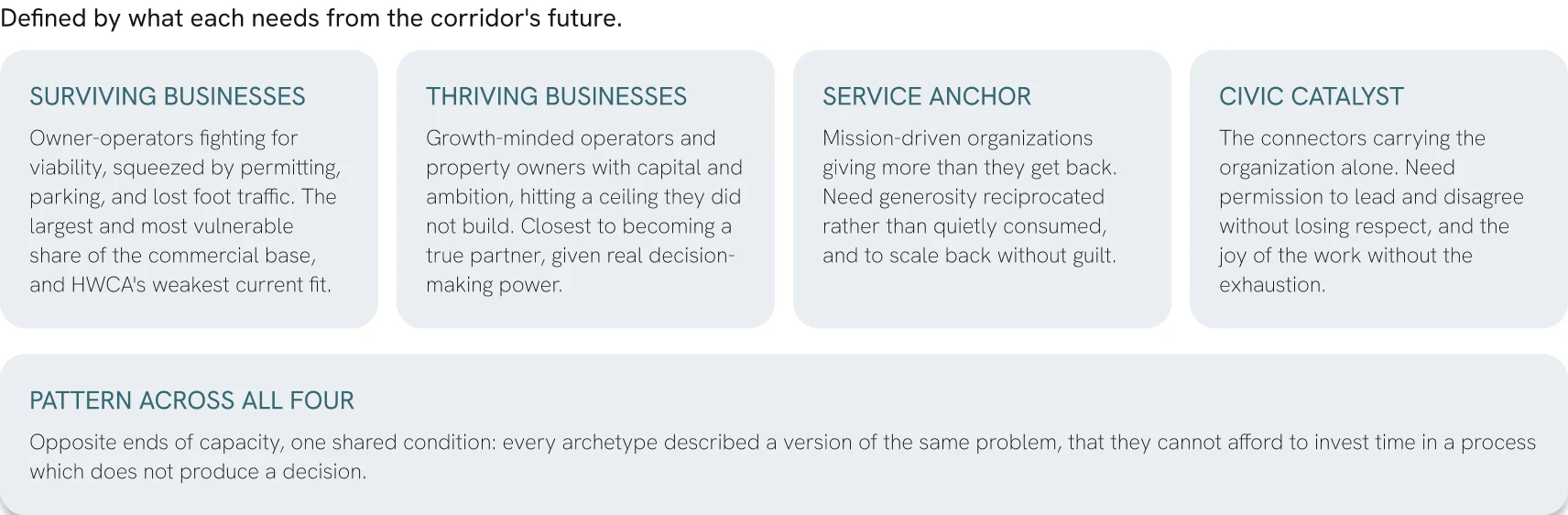
Defined by what each needs from the corridor's future. | PATTERN ACROSS ALL FOUR | Opposite ends of capacity, one shared condition: every archetype described a version of the same problem, that they cannot afford to invest time in a process which does not produce a decision. | SERVICE ANCHOR | Mission-driven organizations giving more than they get back. Need generosity reciprocated rather than quietly consumed, and to scale back without guilt. | CIVIC CATALYST | The connectors carrying the organization alone. Need permission to lead and disagree without losing respect, and the joy of the work

Operational gaps

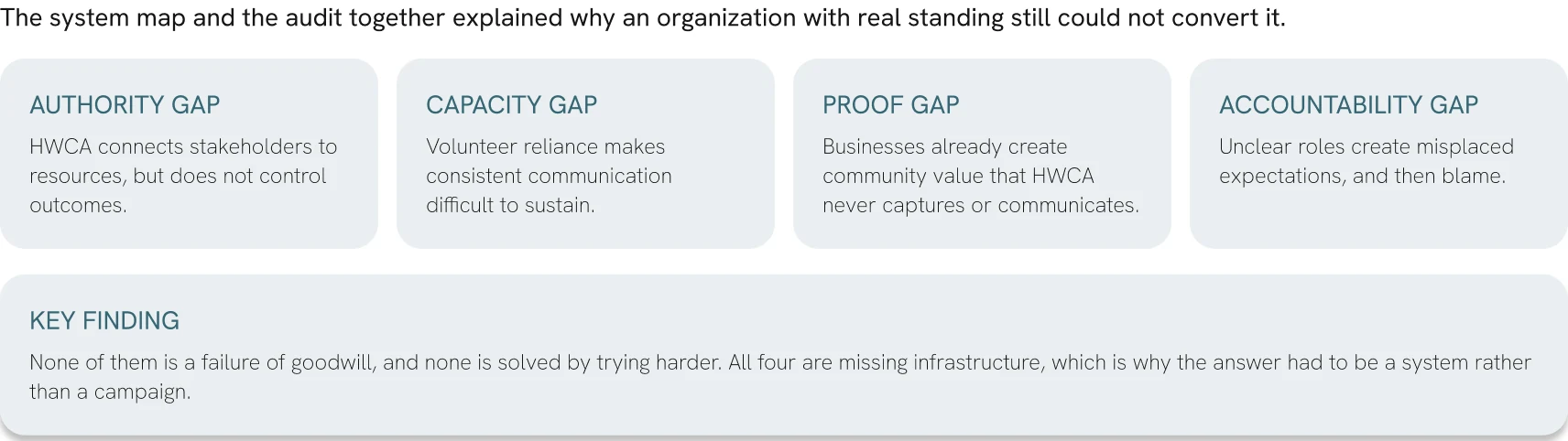
The system map and the audit together explained why an organization with real standing still could not convert it. | PROOF GAP | Businesses already create community value that HWCA never captures or communicates. | ACCOUNTABILITY GAP | Unclear roles create misplaced expectations, and then blame. | AUTHORITY GAP | HWCA connects stakeholders to resources, but does not control outcomes. | KEY FINDING | None of them is a failure of goodwill, and none is solved by trying harder. All four are missing infrastructure, which is why the answer had to be a system rather than a campaign. | CAPACITY GAP |

Opportunities identified

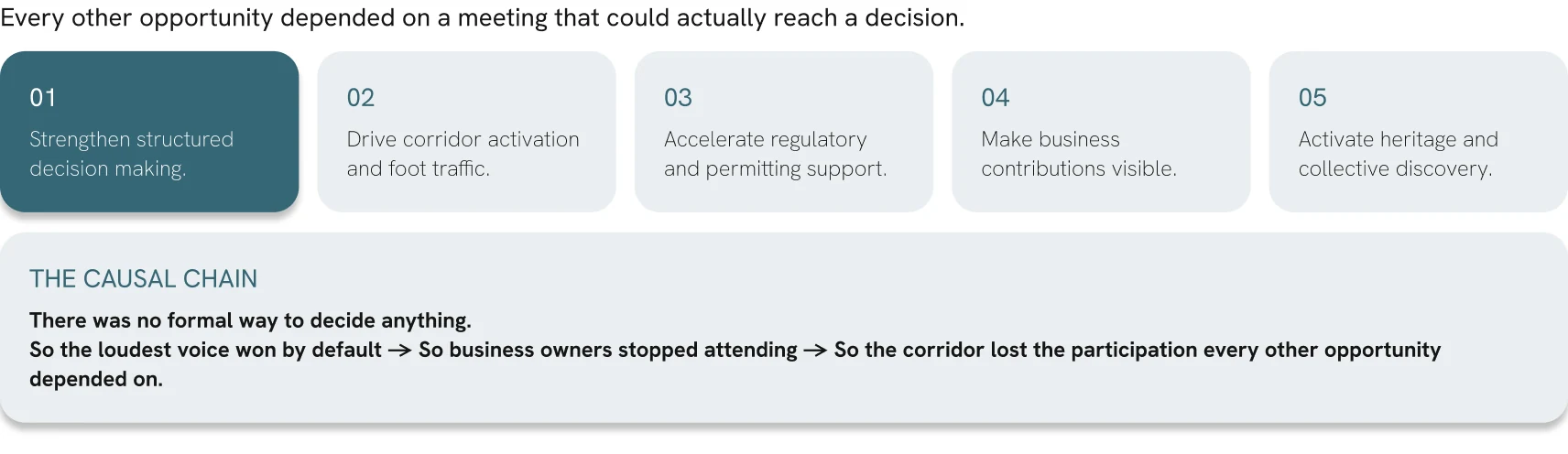
Every other opportunity depended on a meeting that could actually reach a decision. | 03 | Accelerate regulatory and permitting support. | 04 | Make business contributions visible. | 05 | Activate heritage and collective discovery. | THE CAUSAL CHAIN | There was no formal way to decide anything. So the loudest voice won by default → So business owners stopped attending → So the corridor lost the participation every other opportunity depended on. | 01 | Strengthen structured decision making. | 02 | Drive corridor activation and foot traffic.

Objectives, goals, strategies and measures
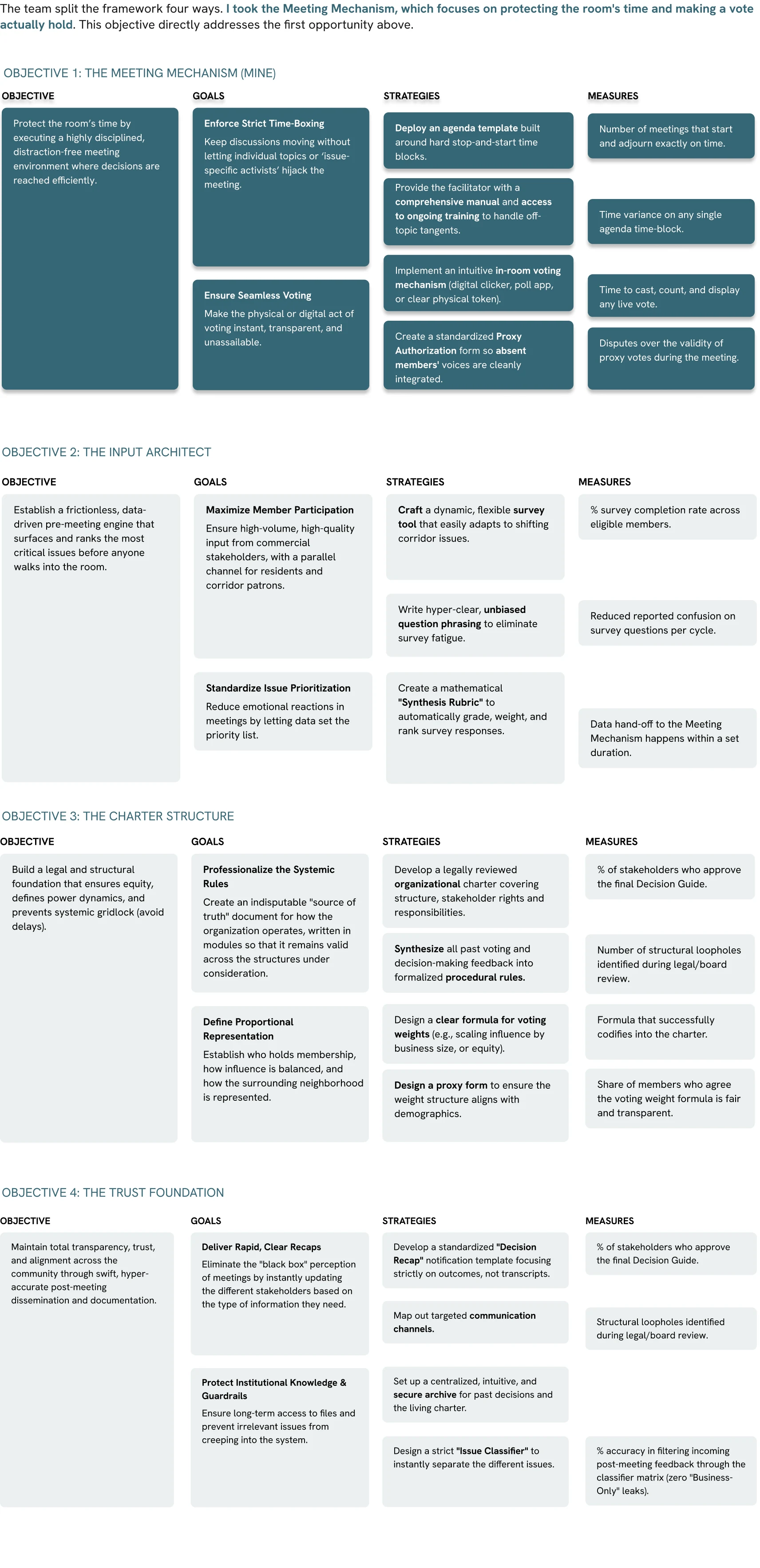
Objective 1: The Meeting Mechanism (mine) | Objective 2: The Input Architect | Objective 3: The Charter Structure | Objective 4: The Trust Foundation | The team split the framework four ways. I took the Meeting Mechanism, which focuses on protecting the room's time and making a vote actually hold. This objective directly addresses the first opportunity above. | STRATEGIES | MEASURES | Objective | Build a legal and structural foundation that ensures equity, defines power dynamics, and prevents systemic gridlock (avoid delays). | GOALS | Professionalize the Systemic Rules | Create an indisputabl

Stakeholder co-creation workshop

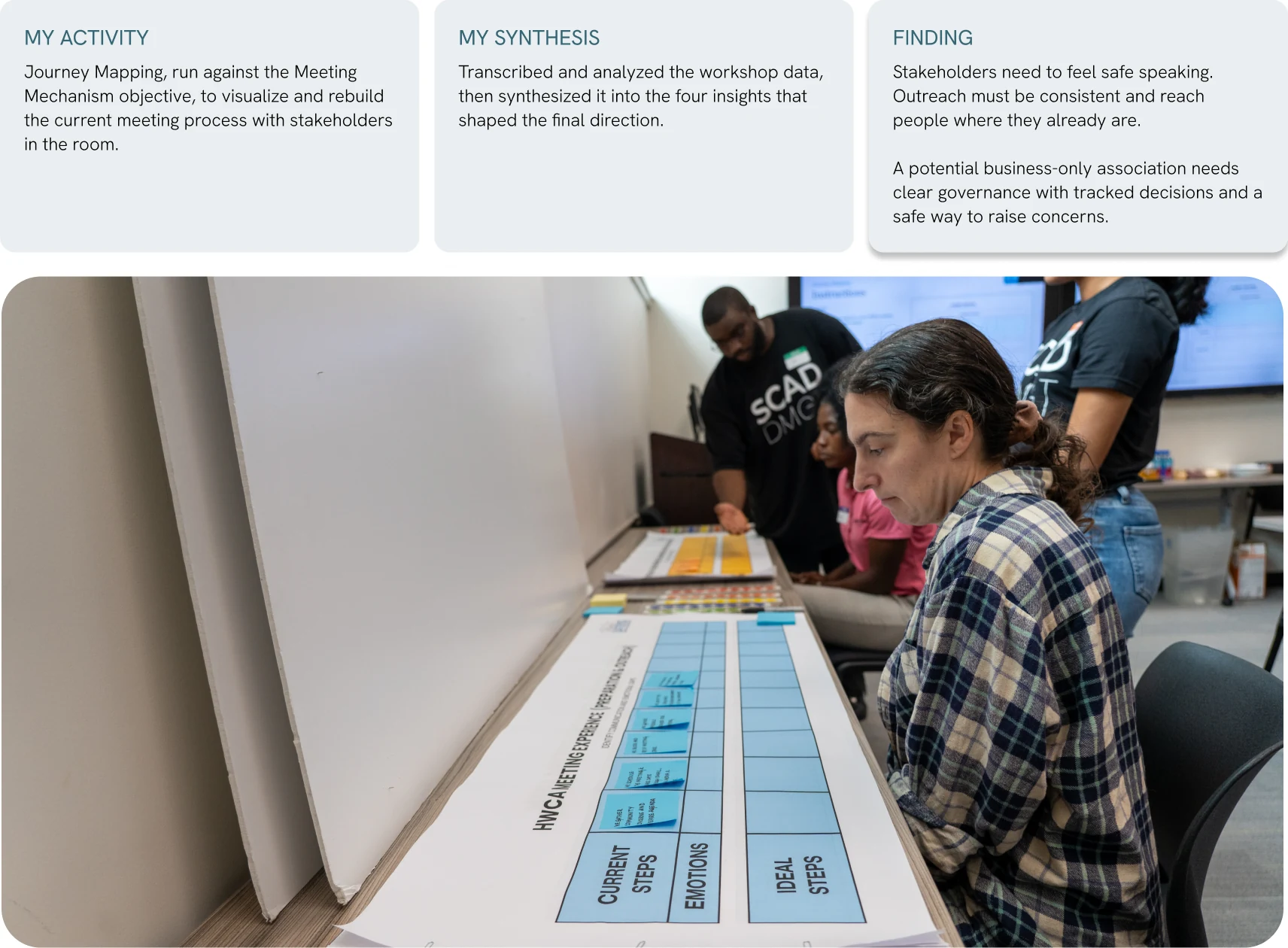
Journey Mapping, run against the Meeting Mechanism objective, to visualize and rebuild the current meeting process with stakeholders in the room. | MY ACTIVITY | Transcribed and analyzed the workshop data, then synthesized it into the four insights that shaped the final direction. | MY SYNTHESIS | Stakeholders need to feel safe speaking. Outreach must be consistent and reach people where they already are. A potential business-only association needs clear governance with tracked decisions and a safe way to raise concerns. | FINDING

Final deliverable

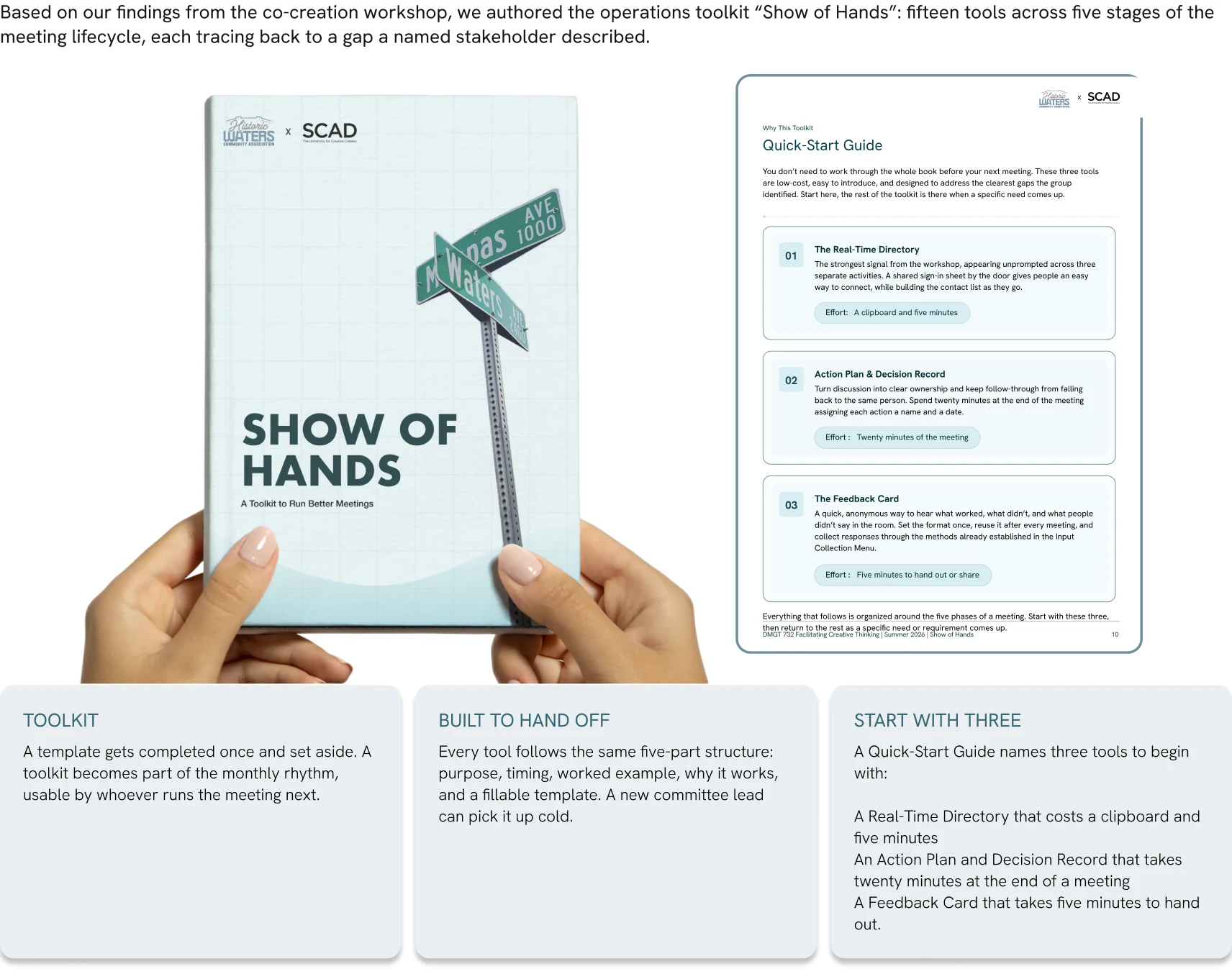
Based on our findings from the co-creation workshop, we authored the operations toolkit “Show of Hands”: fifteen tools across five stages of the meeting lifecycle, each tracing back to a gap a named stakeholder described. | A template gets completed once and set aside. A toolkit becomes part of the monthly rhythm, usable by whoever runs the meeting next. | TOOLKIT | Every tool follows the same five-part structure: purpose, timing, worked example, why it works, and a fillable template. A new committee lead can pick it up cold. | BUILT TO HAND OFF | A Quick-Start Guide names three tools to begin

Project outcomes

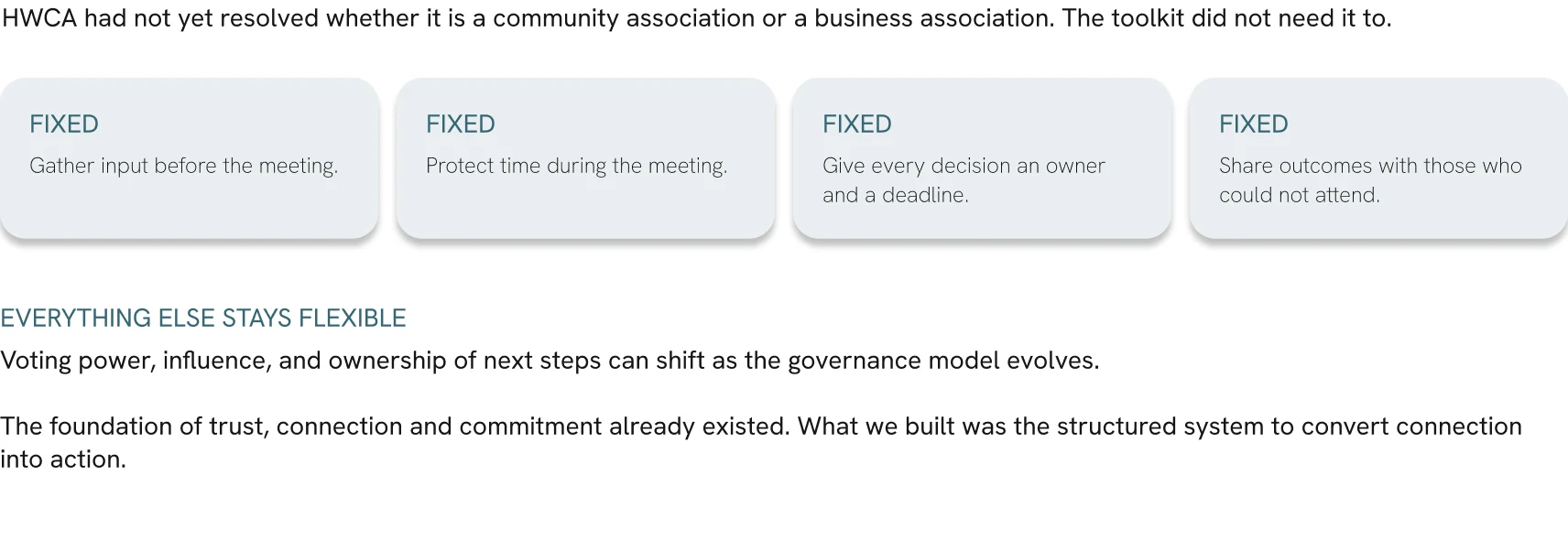
HWCA had not yet resolved whether it is a community association or a business association. The toolkit did not need it to. | Voting power, influence, and ownership of next steps can shift as the governance model evolves. The foundation of trust, connection and commitment already existed. What we built was the structured system to convert connection into action. | Fixed | Give every decision an owner and a deadline. | Fixed | Share outcomes with those who could not attend. | Fixed | EVERYTHING ELSE STAYS FLEXIBLE | Gather input before the meeting. | Fixed | Protect time during the meeting.

The team